
 English
-
English
-
 Español
-
 Português
-
 Русский
-
 Français
-
 日本語
日本語
-
 Deutsch
-
 Tiếng Việt
-
 Italiano
-
 Nederlands
-
 ไทย
ไทย
-
 Polski
-
 한국어
한국어
-
 Svenska
-
 Magyar
-
 Bahasa Melayu
-
 বাংলা
বাংলা
-
 Dansk
Dansk
-
 Suomi
Suomi
-
 हिन्दी
-
 Filipino
-
 Türkçe
-
 Gaeilge
-
 العربية
-
 Bahasa Indonesia
-
 Norsk
Norsk
-
 اردو
اردو
-
 Čeština
-
 Ελληνικά
-
 Українська
-
 Basa Jawa
-
 فارسی
فارسی
-
 தமிழ்
தமிழ்
-
 తెలుగు
-
 नेपाली
-
 မြန်မာ
-
 Български
-
 ລາວ
ລາວ
-
 Latina
-
 Қазақша
-
 Euskera
-
 Azərbaycan
-
 Slovenčina
-
 Македонски
-
 Lietuvių
-
 Eesti
Eesti
-
 Română
-
 Slovenščina

Waterproof System for Steel Structure Buildings: Building a Durable Defense Against Water Damage
In the construction of overseas industrial plants, logistics warehouses, and large-scale public steel structure buildings, the Waterproof System is far more than a supporting component. It is a critical engineering system that safeguards structural durability, ensures reliable facility operation, and maintains site safety and regulatory compliance. Compared with conventional reinforced concrete buildings, steel structure buildings feature lightweight roof and wall panels, numerous connection joints, corrosion-sensitive steel components, and large-span roofs that collect substantial volumes of rainwater. As a result, they require a more comprehensive, efficient, and project-specific drainage strategy.
Many common issues found in overseas steel structure buildings—including steel corrosion, roof leakage, water accumulation around foundations, and damp floor slabs—are not caused by failed waterproofing membranes alone. More often, they result from inadequate drainage design, improper installation, or drainage systems that are poorly matched to local environmental conditions. Drawing on extensive experience in international steel structure projects, HB Steel Structure has developed standardized and systematic drainage solutions tailored to varying rainfall levels, typhoon exposure, snowmelt conditions, coastal salt spray, and other challenging climates. By addressing water management at its source, we help overseas steel structure projects achieve long-term durability and reliable performance.
I. Zoned Drainage Design for Large-Span Steel Structure Buildings
Modern overseas steel structure industrial buildings typically feature expansive roof spans, extensive roof coverage, and highly level roof surfaces. Without a well-planned drainage strategy, rainwater can easily concentrate in localized areas, leading to ponding and drainage overload. To address these characteristics, internationally recognized engineering practices adopt a zoned drainage and directional flow approach rather than relying on conventional, centralized drainage layouts.
During the design stage, the roof is divided into independent drainage zones based on the building configuration, structural grid dimensions, local design storm intensity, and maximum anticipated rainfall. Each zone is assigned its own drainage direction and roof slope to ensure rainwater is collected and discharged evenly and efficiently.
This modular drainage strategy effectively prevents localized ponding and prolonged water retention on large-span steel roofs, reducing continuous moisture exposure that could damage roof cladding systems or accelerate corrosion of steel purlins and truss structures. It provides an ideal drainage solution for overseas factories, logistics centers, warehouses, and commercial steel buildings while significantly enhancing the building's resistance to water intrusion and flooding.
II. Combining Surface and Concealed Drainage to Create a Comprehensive Water Management System
A complete Waterproof System for steel structure buildings consists of three integrated components: roof drainage, wall drainage, and site surface drainage. By combining visible and concealed drainage systems, it establishes a comprehensive three-dimensional water management network that efficiently directs water away from every part of the building.
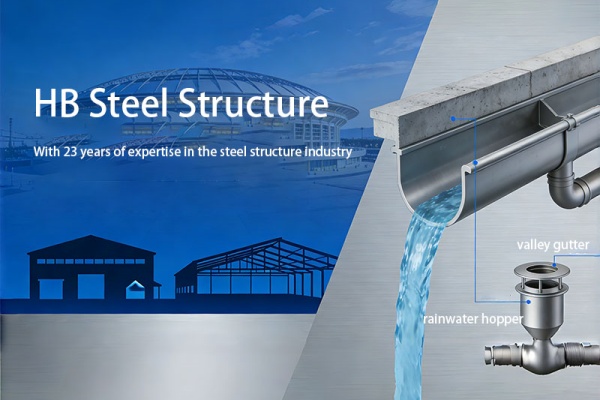
Roof drainage primarily relies on exposed gutters, valley gutters, and downpipes working in conjunction with carefully designed roof slopes to rapidly remove rainwater and melting snow while preventing standing water on roof panels. Vertical drip edges and dedicated wall drainage details are incorporated into exterior walls to prevent rainwater from flowing across wall surfaces or penetrating panel joints.
Around the building, concealed drainage channels and underground pipe networks collect runoff from roofs and paved areas before directing it safely away from the foundation. Compared with conventional drainage methods, this integrated system performs more effectively under heavy rainfall, snowmelt, typhoon conditions, and other severe weather events. It not only handles intense stormwater efficiently but also manages routine surface runoff, providing comprehensive protection for the primary steel structure, building envelope, and foundation system.
III. Designing Around the Characteristics of Steel to Minimize Corrosion Risks
One of the greatest challenges facing steel structure buildings is the susceptibility of exposed steel components to corrosion caused by standing water and prolonged moisture. Poor drainage creates persistently damp conditions that accelerate coating deterioration, steel corrosion, and joint loosening, ultimately shortening the building's service life. Managing these risks is a major priority throughout the lifecycle of overseas steel structure projects.
At HB Steel Structure, drainage systems are designed with the characteristics of steel construction in mind. All drainage components are manufactured from durable, weather-resistant, and corrosion-resistant materials capable of withstanding harsh outdoor environments, including coastal salt spray, acid rain, prolonged UV exposure, and extreme temperatures.
Equally important, drainage details are carefully engineered to prevent water from flowing directly onto steel columns, purlins, or cladding systems, reducing the risk of coating damage and structural deterioration caused by continuous water exposure. By integrating drainage performance with structural corrosion protection, the system significantly lowers future maintenance costs while extending the overall lifespan of the building.
IV. Precision Installation to Eliminate Weak Points in the Drainage System
More than 90% of drainage-related failures in steel structure buildings occur at connection points and transition details. Roof gutter joints, downpipe connections, wall penetrations, equipment curbs, and inside and outside corners are among the most vulnerable areas for water infiltration and therefore receive particular attention during international quality control.
Throughout construction, HB Steel Structure follows strict installation standards for every drainage detail. All joints are sealed, waterproofed, and reinforced to eliminate leakage paths and prevent rainwater backflow.
For roofs containing numerous mechanical units and service penetrations, specially engineered flashing and water-diversion details are incorporated to guide water safely around obstacles without creating areas where water can accumulate. Installation accuracy is also closely monitored to ensure drainage components remain level, properly aligned, and free from low spots or connection offsets that could restrict water flow.
After installation is complete, comprehensive water-spray and ponding tests are conducted to identify any concealed defects, ensuring the entire drainage system delivers leak-free, obstruction-free, and reliable performance before project handover.
V. Maintenance-Friendly Design for Long-Term Overseas Operation
Many overseas projects operate with limited maintenance personnel, high labor costs, and restricted access for future repair work. Consequently, a high-quality Waterproof System must not only provide excellent drainage performance but also be easy to inspect, clean, maintain, and repair throughout the building's service life.
From the earliest design stage, HB Steel Structure incorporates long-term maintenance considerations into every drainage solution. Downpipes, inspection openings, and cleanout points are strategically positioned to minimize debris accumulation from leaves, sediment, and other materials while reducing the likelihood of pipe blockages.
The drainage layout is organized logically with clear access to all major components, allowing routine cleaning, inspection, and replacement work to be completed without dismantling large sections of the building structure. This maintenance-oriented approach significantly reduces lifecycle maintenance costs while ensuring the drainage system continues to perform reliably throughout decades of operation, making it ideally suited to the long-term demands of overseas steel structure buildings.
Many common issues found in overseas steel structure buildings—including steel corrosion, roof leakage, water accumulation around foundations, and damp floor slabs—are not caused by failed waterproofing membranes alone. More often, they result from inadequate drainage design, improper installation, or drainage systems that are poorly matched to local environmental conditions. Drawing on extensive experience in international steel structure projects, HB Steel Structure has developed standardized and systematic drainage solutions tailored to varying rainfall levels, typhoon exposure, snowmelt conditions, coastal salt spray, and other challenging climates. By addressing water management at its source, we help overseas steel structure projects achieve long-term durability and reliable performance.
I. Zoned Drainage Design for Large-Span Steel Structure Buildings
Modern overseas steel structure industrial buildings typically feature expansive roof spans, extensive roof coverage, and highly level roof surfaces. Without a well-planned drainage strategy, rainwater can easily concentrate in localized areas, leading to ponding and drainage overload. To address these characteristics, internationally recognized engineering practices adopt a zoned drainage and directional flow approach rather than relying on conventional, centralized drainage layouts.
During the design stage, the roof is divided into independent drainage zones based on the building configuration, structural grid dimensions, local design storm intensity, and maximum anticipated rainfall. Each zone is assigned its own drainage direction and roof slope to ensure rainwater is collected and discharged evenly and efficiently.
This modular drainage strategy effectively prevents localized ponding and prolonged water retention on large-span steel roofs, reducing continuous moisture exposure that could damage roof cladding systems or accelerate corrosion of steel purlins and truss structures. It provides an ideal drainage solution for overseas factories, logistics centers, warehouses, and commercial steel buildings while significantly enhancing the building's resistance to water intrusion and flooding.
II. Combining Surface and Concealed Drainage to Create a Comprehensive Water Management System
A complete Waterproof System for steel structure buildings consists of three integrated components: roof drainage, wall drainage, and site surface drainage. By combining visible and concealed drainage systems, it establishes a comprehensive three-dimensional water management network that efficiently directs water away from every part of the building.
Roof drainage primarily relies on exposed gutters, valley gutters, and downpipes working in conjunction with carefully designed roof slopes to rapidly remove rainwater and melting snow while preventing standing water on roof panels. Vertical drip edges and dedicated wall drainage details are incorporated into exterior walls to prevent rainwater from flowing across wall surfaces or penetrating panel joints.
Around the building, concealed drainage channels and underground pipe networks collect runoff from roofs and paved areas before directing it safely away from the foundation. Compared with conventional drainage methods, this integrated system performs more effectively under heavy rainfall, snowmelt, typhoon conditions, and other severe weather events. It not only handles intense stormwater efficiently but also manages routine surface runoff, providing comprehensive protection for the primary steel structure, building envelope, and foundation system.
III. Designing Around the Characteristics of Steel to Minimize Corrosion Risks
One of the greatest challenges facing steel structure buildings is the susceptibility of exposed steel components to corrosion caused by standing water and prolonged moisture. Poor drainage creates persistently damp conditions that accelerate coating deterioration, steel corrosion, and joint loosening, ultimately shortening the building's service life. Managing these risks is a major priority throughout the lifecycle of overseas steel structure projects.
At HB Steel Structure, drainage systems are designed with the characteristics of steel construction in mind. All drainage components are manufactured from durable, weather-resistant, and corrosion-resistant materials capable of withstanding harsh outdoor environments, including coastal salt spray, acid rain, prolonged UV exposure, and extreme temperatures.
Equally important, drainage details are carefully engineered to prevent water from flowing directly onto steel columns, purlins, or cladding systems, reducing the risk of coating damage and structural deterioration caused by continuous water exposure. By integrating drainage performance with structural corrosion protection, the system significantly lowers future maintenance costs while extending the overall lifespan of the building.
IV. Precision Installation to Eliminate Weak Points in the Drainage System
More than 90% of drainage-related failures in steel structure buildings occur at connection points and transition details. Roof gutter joints, downpipe connections, wall penetrations, equipment curbs, and inside and outside corners are among the most vulnerable areas for water infiltration and therefore receive particular attention during international quality control.
Throughout construction, HB Steel Structure follows strict installation standards for every drainage detail. All joints are sealed, waterproofed, and reinforced to eliminate leakage paths and prevent rainwater backflow.
For roofs containing numerous mechanical units and service penetrations, specially engineered flashing and water-diversion details are incorporated to guide water safely around obstacles without creating areas where water can accumulate. Installation accuracy is also closely monitored to ensure drainage components remain level, properly aligned, and free from low spots or connection offsets that could restrict water flow.
After installation is complete, comprehensive water-spray and ponding tests are conducted to identify any concealed defects, ensuring the entire drainage system delivers leak-free, obstruction-free, and reliable performance before project handover.
V. Maintenance-Friendly Design for Long-Term Overseas Operation
Many overseas projects operate with limited maintenance personnel, high labor costs, and restricted access for future repair work. Consequently, a high-quality Waterproof System must not only provide excellent drainage performance but also be easy to inspect, clean, maintain, and repair throughout the building's service life.
From the earliest design stage, HB Steel Structure incorporates long-term maintenance considerations into every drainage solution. Downpipes, inspection openings, and cleanout points are strategically positioned to minimize debris accumulation from leaves, sediment, and other materials while reducing the likelihood of pipe blockages.
The drainage layout is organized logically with clear access to all major components, allowing routine cleaning, inspection, and replacement work to be completed without dismantling large sections of the building structure. This maintenance-oriented approach significantly reduces lifecycle maintenance costs while ensuring the drainage system continues to perform reliably throughout decades of operation, making it ideally suited to the long-term demands of overseas steel structure buildings.
Related News
- Building a Strong Foundation for Steel Structure Manufacturing Plant Development
- Steel Structure Concert Hall: Long-Term Construction Advantages for Premium Performing Arts Venues
- Steel Structure Factory Building Column Base Design: Building a Strong Foundation for Industrial Structures
- Steel Structure Office Building: An Adaptable Solution for Modern Commercial Architecture
- Four Core Systems That Drive the Industrialization of Steel Structure Residential Buildings
- Steel Structure Dormitory: A Modern Modular Housing Solution for Overseas Projects


Leave me a message