
 English
-
English
-
 Español
-
 Português
-
 Русский
-
 Français
-
 日本語
日本語
-
 Deutsch
-
 Tiếng Việt
-
 Italiano
-
 Nederlands
-
 ไทย
ไทย
-
 Polski
-
 한국어
한국어
-
 Svenska
-
 Magyar
-
 Bahasa Melayu
-
 বাংলা
বাংলা
-
 Dansk
Dansk
-
 Suomi
Suomi
-
 हिन्दी
-
 Filipino
-
 Türkçe
-
 Gaeilge
-
 العربية
-
 Bahasa Indonesia
-
 Norsk
Norsk
-
 اردو
اردو
-
 Čeština
-
 Ελληνικά
-
 Українська
-
 Basa Jawa
-
 فارسی
فارسی
-
 தமிழ்
தமிழ்
-
 తెలుగు
-
 नेपाली
-
 မြန်မာ
-
 Български
-
 ລາວ
ລາວ
-
 Latina
-
 Қазақша
-
 Euskera
-
 Azərbaycan
-
 Slovenčina
-
 Македонски
-
 Lietuvių
-
 Eesti
Eesti
-
 Română
-
 Slovenščina

Steel Structure Concert Hall: Long-Term Construction Advantages for Premium Performing Arts Venues
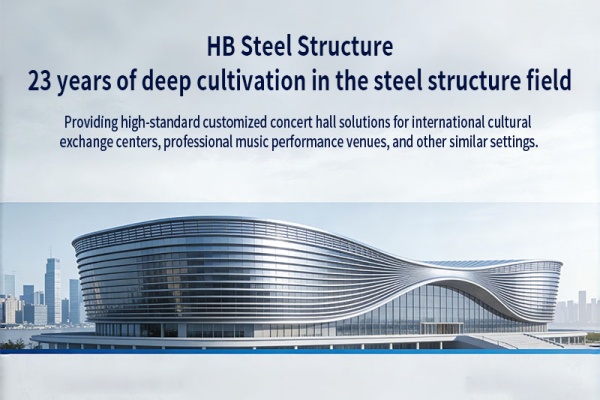
In the global market for premium cultural, tourism, and public arts facilities, a Steel Structure Concert Hall is fundamentally different from a conventional commercial building. Beyond architectural aesthetics, it must support year-round performances, accommodate dense technical installations, and maintain stable temperature and humidity around the clock. Traditional reinforced concrete concert halls often face limitations such as insufficient roof load capacity, inadequate thermal performance, restricted flexibility for equipment upgrades, limited structural redundancy, and high long-term maintenance costs. Many aging performance venues overseas begin to experience ceiling deformation, aging infrastructure, and spaces that can no longer accommodate modern performance technologies after only a decade or two of operation.
Drawing on extensive international project experience, HB Steel Structure goes beyond conventional discussions of acoustics and architectural appearance. From the perspectives of long-term venue operation, equipment load capacity, environmental stability, structural safety, and commercial adaptability, we explore the unique advantages of modern Steel Structure Concert Hall construction, delivering durable and future-ready solutions for performing arts venues worldwide.
I. Exceptional Roof Suspension Capacity for High-Density Performance Equipment
Today's professional concert halls are no longer limited to traditional orchestral performances. They regularly host symphony concerts, multimedia productions, immersive performances, lighting shows, and large-scale cultural events, all of which require extensive overhead equipment installations. These include acoustic reflector ceilings, stage lighting trusses, large LED displays, line-array speaker systems, motorized rigging equipment, adjustable acoustic banners, and other specialized systems that impose significant concentrated loads.
Conventional concrete roofs often have limited load-bearing capacity, making later equipment installation difficult and requiring costly structural reinforcement while restricting suspension locations.
A steel truss roof system provides outstanding structural strength with evenly distributed load transfer, allowing suspension points to be positioned wherever required without extensive reinforcement. During the design phase, standardized rigging supports and structural connection points can be incorporated according to the venue's technical requirements, enabling multiple heavy-load suspension locations and high-density equipment layouts. This provides the flexibility needed to support the evolving demands of immersive, multifunctional, and technology-driven performance venues while preserving ample structural capacity for future upgrades.
II. High-Performance Building Envelope for Stable Temperature and Humidity Control
Instrument performance, acoustic quality, and audience comfort all depend on maintaining a stable indoor environment. As a result, concert halls demand significantly higher standards for thermal insulation, moisture protection, airtightness, and energy efficiency than conventional public buildings.
Traditional wall and roof systems often suffer from inadequate sealing and excessive thermal transfer, resulting in higher HVAC energy consumption and fluctuations in temperature and humidity that can negatively affect instrument resonance and acoustic consistency.
A Steel Structure Concert Hall can be integrated with a high-performance insulated building envelope featuring thermally broken steel framing and precision sealing throughout the enclosure. This effectively eliminates thermal bridges while providing excellent airtightness, balanced insulation, and reliable moisture control.
The result is a stable indoor environment with minimal temperature and humidity fluctuations, protecting performance quality while significantly reducing the long-term energy consumption of air conditioning and ventilation systems. This approach aligns perfectly with the sustainability and operational efficiency standards expected of modern international public buildings.
III. High Structural Redundancy for Continuous Public Operation
Public concert halls are landmark cultural facilities that welcome large visitor volumes and operate continuously throughout the year. Consequently, they demand exceptional structural redundancy, seismic resilience, deformation resistance, and long-term durability.
Concrete structures, while inherently strong in compression, are more susceptible to brittle behavior and fatigue-related deterioration over time. Continuous use may eventually result in concealed cracking, surface deterioration, and maintenance challenges that are difficult to detect during routine inspections.
Steel structural systems provide superior ductility, excellent fatigue resistance, and greater structural redundancy. They effectively accommodate dynamic crowd loads, suspended equipment loads, and seasonal thermal movement without compromising structural integrity.
Because steel member s have clearly defined load paths and easily accessible connection details, routine inspections and preventive maintenance become more straightforward, allowing potential issues to be identified before they develop into major concerns. Even under decades of intensive public use, a steel structure maintains its stability, dimensional accuracy, and operational reliability, providing a higher level of safety for both operators and visitors.
IV. Modular Structural Planning for Future Venue Upgrades
The global performing arts industry continues to evolve rapidly. Audience expectations, stage technologies, lighting systems, acoustic equipment, and immersive production methods are constantly advancing, requiring concert halls to undergo regular modernization.
Traditional concrete venues offer limited flexibility for renovation. Structural modifications often require demolition work that may compromise both the original building structure and carefully designed acoustic performance, resulting in lengthy construction periods, high costs, and increased project risks.
A Steel Structure Concert Hall adopts a design philosophy based on a permanent structural framework combined with adaptable interior systems. While the primary steel frame remains durable and stable, interior spaces, suspended ceilings, technical infrastructure, and equipment layouts can be reconfigured with minimal disruption.
Whether upgrading to immersive stage technology, replacing acoustic systems, installing intelligent performance equipment, or renovating audience seating, improvements can be completed efficiently without affecting the primary structural system. This flexibility allows concert halls to continuously adapt to evolving industry requirements, extending the commercial life of the facility while avoiding premature obsolescence.
V. Lightweight Structural Solutions for Complex Urban Cultural Sites
Many international concert halls are located within historic city centers, waterfront cultural districts, or urban arts precincts, where development sites often present challenging foundation conditions, existing underground utilities, or restricted construction environments.
Conventional reinforced concrete buildings impose substantial foundation loads, increasing excavation requirements, foundation costs, and construction complexity.
Steel structures typically weigh only about one-third as much as comparable concrete buildings, significantly reducing foundation loading requirements. This makes them well suited for redevelopment sites, historic urban districts, waterfront locations, and areas with relatively weak soil conditions.
With reduced demands for extensive excavation, soil replacement, or deep foundation reinforcement, steel construction lowers both foundation costs and construction difficulty. These advantages make it an ideal structural solution for urban regeneration projects, waterfront cultural developments, and city-center performing arts districts throughout the world.
Delivering Long-Term Value for World-Class Performing Arts Facilities
Rather than focusing solely on construction efficiency, today's premium concert halls must provide long-term operational performance, technical flexibility, environmental stability, and the capacity to accommodate future innovations. A Steel Structure Concert Hall addresses these objectives through its superior heavy-load capacity, controlled indoor environment, high structural redundancy, outstanding adaptability, and broad site compatibility, overcoming many of the operational limitations associated with traditional performance venues.
Looking ahead, HB Steel Structure will continue advancing the design and construction of steel structures for cultural, performing arts, and tourism projects. By continuously refining long-life structural systems engineered for operational excellence, we remain committed to delivering safer, more energy-efficient, highly durable, and future-ready performing arts landmarks for cities around the world.
Drawing on extensive international project experience, HB Steel Structure goes beyond conventional discussions of acoustics and architectural appearance. From the perspectives of long-term venue operation, equipment load capacity, environmental stability, structural safety, and commercial adaptability, we explore the unique advantages of modern Steel Structure Concert Hall construction, delivering durable and future-ready solutions for performing arts venues worldwide.
I. Exceptional Roof Suspension Capacity for High-Density Performance Equipment
Today's professional concert halls are no longer limited to traditional orchestral performances. They regularly host symphony concerts, multimedia productions, immersive performances, lighting shows, and large-scale cultural events, all of which require extensive overhead equipment installations. These include acoustic reflector ceilings, stage lighting trusses, large LED displays, line-array speaker systems, motorized rigging equipment, adjustable acoustic banners, and other specialized systems that impose significant concentrated loads.
Conventional concrete roofs often have limited load-bearing capacity, making later equipment installation difficult and requiring costly structural reinforcement while restricting suspension locations.
A steel truss roof system provides outstanding structural strength with evenly distributed load transfer, allowing suspension points to be positioned wherever required without extensive reinforcement. During the design phase, standardized rigging supports and structural connection points can be incorporated according to the venue's technical requirements, enabling multiple heavy-load suspension locations and high-density equipment layouts. This provides the flexibility needed to support the evolving demands of immersive, multifunctional, and technology-driven performance venues while preserving ample structural capacity for future upgrades.
II. High-Performance Building Envelope for Stable Temperature and Humidity Control
Instrument performance, acoustic quality, and audience comfort all depend on maintaining a stable indoor environment. As a result, concert halls demand significantly higher standards for thermal insulation, moisture protection, airtightness, and energy efficiency than conventional public buildings.
Traditional wall and roof systems often suffer from inadequate sealing and excessive thermal transfer, resulting in higher HVAC energy consumption and fluctuations in temperature and humidity that can negatively affect instrument resonance and acoustic consistency.
A Steel Structure Concert Hall can be integrated with a high-performance insulated building envelope featuring thermally broken steel framing and precision sealing throughout the enclosure. This effectively eliminates thermal bridges while providing excellent airtightness, balanced insulation, and reliable moisture control.
The result is a stable indoor environment with minimal temperature and humidity fluctuations, protecting performance quality while significantly reducing the long-term energy consumption of air conditioning and ventilation systems. This approach aligns perfectly with the sustainability and operational efficiency standards expected of modern international public buildings.
III. High Structural Redundancy for Continuous Public Operation
Public concert halls are landmark cultural facilities that welcome large visitor volumes and operate continuously throughout the year. Consequently, they demand exceptional structural redundancy, seismic resilience, deformation resistance, and long-term durability.
Concrete structures, while inherently strong in compression, are more susceptible to brittle behavior and fatigue-related deterioration over time. Continuous use may eventually result in concealed cracking, surface deterioration, and maintenance challenges that are difficult to detect during routine inspections.
Steel structural systems provide superior ductility, excellent fatigue resistance, and greater structural redundancy. They effectively accommodate dynamic crowd loads, suspended equipment loads, and seasonal thermal movement without compromising structural integrity.
Because steel member s have clearly defined load paths and easily accessible connection details, routine inspections and preventive maintenance become more straightforward, allowing potential issues to be identified before they develop into major concerns. Even under decades of intensive public use, a steel structure maintains its stability, dimensional accuracy, and operational reliability, providing a higher level of safety for both operators and visitors.
IV. Modular Structural Planning for Future Venue Upgrades
The global performing arts industry continues to evolve rapidly. Audience expectations, stage technologies, lighting systems, acoustic equipment, and immersive production methods are constantly advancing, requiring concert halls to undergo regular modernization.
Traditional concrete venues offer limited flexibility for renovation. Structural modifications often require demolition work that may compromise both the original building structure and carefully designed acoustic performance, resulting in lengthy construction periods, high costs, and increased project risks.
A Steel Structure Concert Hall adopts a design philosophy based on a permanent structural framework combined with adaptable interior systems. While the primary steel frame remains durable and stable, interior spaces, suspended ceilings, technical infrastructure, and equipment layouts can be reconfigured with minimal disruption.
Whether upgrading to immersive stage technology, replacing acoustic systems, installing intelligent performance equipment, or renovating audience seating, improvements can be completed efficiently without affecting the primary structural system. This flexibility allows concert halls to continuously adapt to evolving industry requirements, extending the commercial life of the facility while avoiding premature obsolescence.
V. Lightweight Structural Solutions for Complex Urban Cultural Sites
Many international concert halls are located within historic city centers, waterfront cultural districts, or urban arts precincts, where development sites often present challenging foundation conditions, existing underground utilities, or restricted construction environments.
Conventional reinforced concrete buildings impose substantial foundation loads, increasing excavation requirements, foundation costs, and construction complexity.
Steel structures typically weigh only about one-third as much as comparable concrete buildings, significantly reducing foundation loading requirements. This makes them well suited for redevelopment sites, historic urban districts, waterfront locations, and areas with relatively weak soil conditions.
With reduced demands for extensive excavation, soil replacement, or deep foundation reinforcement, steel construction lowers both foundation costs and construction difficulty. These advantages make it an ideal structural solution for urban regeneration projects, waterfront cultural developments, and city-center performing arts districts throughout the world.
Delivering Long-Term Value for World-Class Performing Arts Facilities
Rather than focusing solely on construction efficiency, today's premium concert halls must provide long-term operational performance, technical flexibility, environmental stability, and the capacity to accommodate future innovations. A Steel Structure Concert Hall addresses these objectives through its superior heavy-load capacity, controlled indoor environment, high structural redundancy, outstanding adaptability, and broad site compatibility, overcoming many of the operational limitations associated with traditional performance venues.
Looking ahead, HB Steel Structure will continue advancing the design and construction of steel structures for cultural, performing arts, and tourism projects. By continuously refining long-life structural systems engineered for operational excellence, we remain committed to delivering safer, more energy-efficient, highly durable, and future-ready performing arts landmarks for cities around the world.
Related News
- Building a Strong Foundation for Steel Structure Manufacturing Plant Development
- Waterproof System for Steel Structure Buildings: Building a Durable Defense Against Water Damage
- Steel Structure Factory Building Column Base Design: Building a Strong Foundation for Industrial Structures
- Steel Structure Office Building: An Adaptable Solution for Modern Commercial Architecture
- Four Core Systems That Drive the Industrialization of Steel Structure Residential Buildings
- Steel Structure Dormitory: A Modern Modular Housing Solution for Overseas Projects


Leave me a message